Automatic Pressure Modifier
APM
APM = Automatic Pressure Modifier
Objectives
After completing this chapter, you will be able to understand
In the previous chapter on Load Sensing Devices (LSD), we learned that two different types of brake forces are required for each empty and loaded condition of the wagon. This adjustment is achieved by using the Load Sensing Device, which was discussed in detail in that chapter.
In recent developments, RDSO (Research Designs and Standards Organisation) has introduced the Automatic Pressure Modifier (APM) to replace the LSD in upcoming wagon models to perform the above function more effectively and reliably.
Advantages of APM over LSD
Disadvantages of LSD
The Load Sensing Device (LSD) has several limitations, which have prompted the shift toward APM:
The shift from LSD to APM represents a significant technological advancement in railway braking systems. APM offers greater accuracy, reliability, and lower maintenance costs, making it a more effective solution for modern railway operations.
Due to the limitations of Load Sensing Devices (LSD), APM is being introduced in upcoming wagon models to enhance braking performance and reliability.
What is APM?
APM = Automatic Pressure Modifier

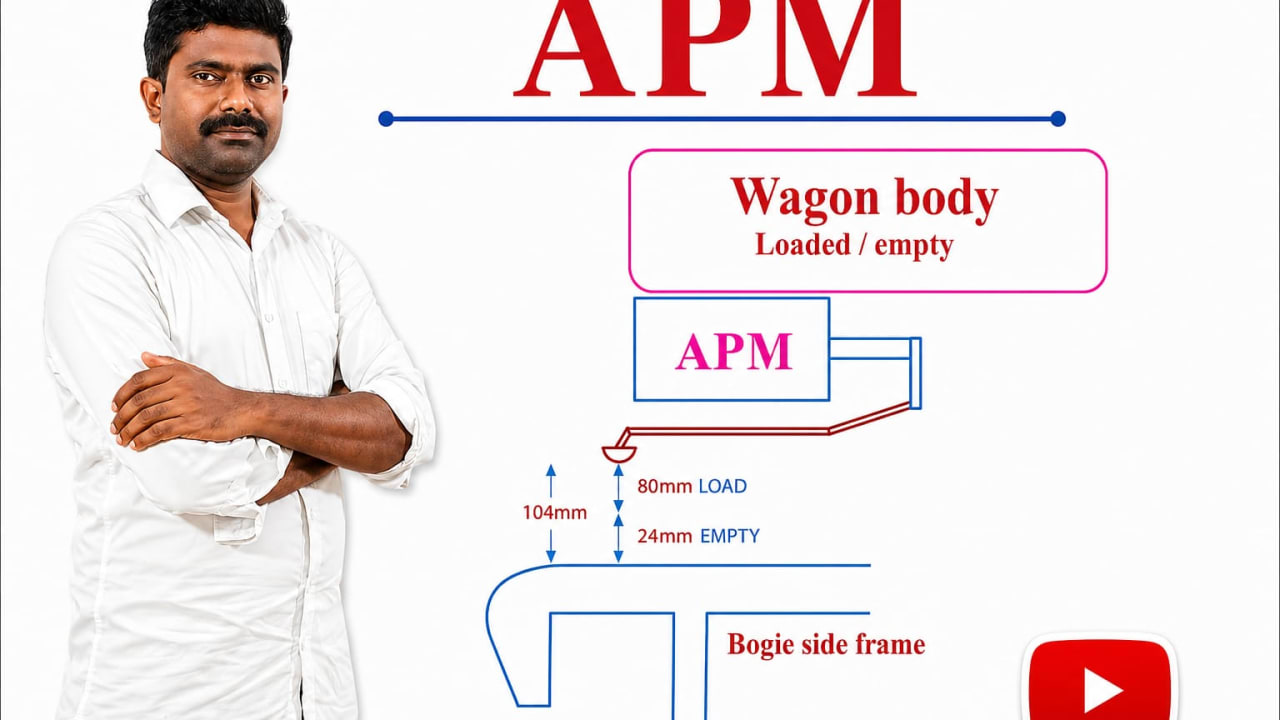
APM stands for Automatic Pressure Modifier. As the name indicates, it automatically adjusts the brake force pressure of a wagon depending on whether it is in Loaded or Empty condition. APM is an advanced version of the Load Sensing Device (LSD). The primary objective of both APM and LSD is the same — to provide different brake force levels for Loaded and Empty wagon conditions. However, their construction, design features, and working principles are different. The APM senses the load condition of the wagon based on the relative spacing between its handle (or sensing lever) and the bogie side frame. In the above figure, the APM is shown mounted between the wagon body and the side frame of the bogie. The APM handle maintains a specific clearance from the bogie side frame, which varies according to the wagon’s load condition. This change in spacing enables the APM to mechanically determine whether the wagon is Loaded or Empty and accordingly modifies the brake cylinder pressure. Generally, the maximum permissible spacing between the APM sensing handle and the bogie side frame is approximately 104 mm. When this spacing falls below the specified range due to deflection of the wagon body under load, the APM automatically adjusts the brake force pressure. Hence, based on the handle position and clearance, the APM ensures correct brake force application higher brake pressure for Loaded condition and reduced brake pressure for Empty condition. thereby improving braking efficiency, wheel protection, and overall safety.
How The APM Is Linked With Air Brake Circuit

The above figure clearly illustrates how the Automatic Pressure Modifier (APM) is interconnected with the remaining components of the air brake circuit. The APM is provided with a visual indicator, which has two distinct positions: Orange colour and No colour. During Empty wagon operation, the indicator displays Orange colour, whereas during Loaded wagon operation, the indicator shows No colour. By observing this indicator, the operating staff can easily identify whether the APM is functioning in Loaded or Empty mode.
The maximum allowable spacing between the APM handle and the bogie side frame is 104 mm. When the wagon is loaded with coal, cement, or similar bulk materials, the wagon body settles downward due to the weight of the load and the compression of the bogie suspension system (springs). As the wagon body moves downward, the clearance between the APM handle and the bogie side frame reduces from the maximum value of 104 mm.
When the spacing falls within the range of 0 mm to 80 mm, the APM senses the Loaded condition and supplies the maximum brake force pressure of approximately 3.8 kg/cm² to the brake cylinders. In this condition, the APM indicator shows No colour, indicating higher brake force suitable for the Loaded wagon condition.
When the APM handle is positioned within the range of 80 mm to 104 mm from the bogie side frame (i.e., the remaining 24 mm from the maximum permissible spacing of 104 mm), the APM interprets the wagon as being in Empty condition. Under this condition, the APM delivers minimum brake force pressure of approximately 2.2 kg/cm² to the brake cylinders. During Empty condition operation, the APM indicator displays Orange colour, clearly indicating reduced brake force.
APM Operation in Empty Wagon Condition

The above figure illustrates the working of the Automatic Pressure Modifier (APM) in Empty wagon condition. When the wagon is empty, the APM handle occupies a position within the 80 mm to 104 mm range, indicating that the wagon load is minimal. In this position, the APM identifies the wagon as being in Empty condition and automatically regulates the brake force to a reduced pressure of 2.2 kg/cm².
The APM is externally connected to an auxiliary air reservoir of 6.6 litres capacity, which is used to receive any excess air from the APM during brake applications. When the loco pilot initiates braking by reducing the brake pipe pressure below 5 kg/cm², the distributor valve supplies compressed air to the APM. In response, the APM delivers only 2.2 kg/cm² pressure to the brake cylinders, which is adequate for safely stopping an Empty wagon without causing wheel skidding. The remaining excess air, not required by the brake cylinders, is automatically diverted to the 6.6-litre auxiliary reservoir.
Thus, the primary function of the APM to ensure a reduced brake cylinder pressure of 2.2 kg/cm² under Empty condition is effectively achieved. During this mode, the APM indicator displays Orange colour, clearly confirming that the device is operating in Empty wagon condition.
Indicator Mechanism on empty wagon
The APM is equipped with an indicator to visually signal the wagon’s load (or) empty condition. When the wagon is in an empty state, the indicator will display an orange color. If the indicator shows orange, it confirms that the APM is functioning in empty condition mode, thereby ensuring that the correct pressure of 2.2 kg/cm² is applied to the brake cylinders.
The feedback from the indicator provides a quick visual confirmation for maintenance and operational staff, ensuring accurate monitoring of wagon conditions.
APM Operation in loaded Wagon Condition

The above figure illustrates the working of the Automatic Pressure Modifier (APM) in Loaded wagon condition. For a loaded wagon, the APM handle occupies a position within the 0 mm to 80 mm range, indicating that the wagon is under load. In this position, the APM senses the Loaded condition and takes a position to deliver the maximum brake cylinder pressure of 3.8 kg/cm².
When the loco pilot initiates brake application by reducing the brake pipe pressure below 5 kg/cm², the distributor valve supplies compressed air to the APM. During Loaded condition, the APM is required to deliver 3.8 kg/cm² pressure to the brake cylinders. If the air received from the distributor valve is insufficient to meet this required pressure, the APM supplements the deficit by drawing additional air from the 6.6 liter auxiliary reservoir, which is externally connected to the APM. This ensures that under Loaded wagon condition, the APM consistently provides the required maximum brake force necessary for effective braking of heavy loads. Thus, the main objective of delivering 3.8kg/cm² brake cylinder pressure in Loaded condition is successfully achieved.
During this condition, the APM indicator shows No colour, clearly confirming that the APM is operating in Loaded mode. This indicator assists maintenance and operating staff in verifying the correct functioning of the APM according to wagon load status.
Indicator Mechanism on loaded wagon
The APM is equipped with an indicator to visually signal the wagon’s load (or) empty condition. When the wagon is in loaded state, the indicator will display an No color. If the indicator shows No colour, it confirms that the APM is functioning in loaded condition mode, thereby ensuring that the correct pressure of 3.8 kg/cm² is applied to the brake cylinders. The feedback from the indicator provides a quick visual confirmation for maintenance and operational staff, ensuring accurate monitoring of wagon conditions.
Golden points
