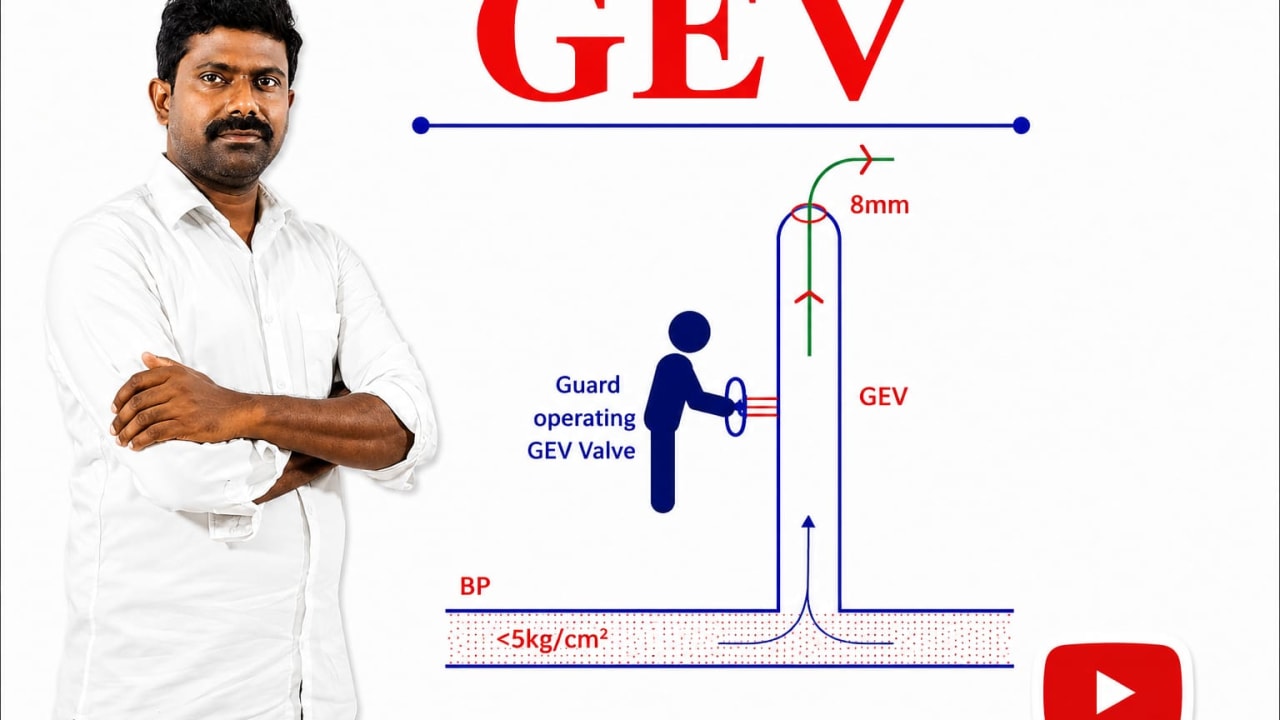
Guard Emergency Brake Valve
Guard emergency brake valve
Objectives
After completing this chapter, you will be able to understand

A goods guard operating the brake valve inside the brake van
GEV The name itself indicates that there is a brake valve available with the guard, which can be used to apply the brakes to the train during emergency situations. This valve serves as a critical safety mechanism to prevent accidents and ensure the safety of passengers and railway staff.
In previous discussions, we have learned that a moving train can be stopped in two primary ways:
1. By pulling the Passenger Emergency Alarm Chain – Passengers can pull the emergency alarm chain provided in every coach, which activates the braking system and brings the train to a stop.
2. By using the A9 handle by the Loco Pilot – The loco pilot can operate the A9 handle in the locomotive to engage the braking system and stop the train.
In addition to the above methods, the guard is also equipped with a special brake valve to stop the train in case of an emergency. The guard is typically stationed in the brake van, which is the last vehicle of the train formation. This strategic position allows the guard to monitor the train's condition and respond quickly to any emergency.
The guard can apply the brake using the emergency brake valve in the following situations:
Working Principle of GEV

The above figure illustrates the internal construction of the Guard Emergency Brake Valve (GEV). It resembles a simple water tap-like structure and is directly connected to the brake pipe of the train. The GEV is equipped with an 8mm exhaust choke in wagons (in LHB coaches it is 19mm) that helps to vent out brake pipe (BP) pressure when the GEV is operated. This mechanism allows the brake system to engage effectively during emergency situations, ensuring the safety of the train and its passengers.
The working of the Guard Emergency Brake Valve can be explained under two conditions:
1. Normal Condition
2. Emergency Condition
1. Normal Condition
In normal conditions, the guard is seated in the brake van, which is positioned at the last vehicle of the train. The guard continuously monitors the movement and overall condition of the train. If the guard does not detect any unusual or emergency, the train will continue to operate smoothly. The brake valve remains closed under normal conditions, ensuring that the brake pipe pressure remains stable at 5 kg/cm². Since the valve is not opened, the brake system is not activated, and the train continues to run without any disruption.
The stability of the brake pipe pressure at 5 kg/cm² under normal conditions ensures that the brakes are not applied, allowing the train to maintain a steady and safe operation.
2. Emergency Condition

At some point during the running of the train, the guard, who is seated in the brake van (the last vehicle of the train), may notice an emergency condition that requires immediate action to prevent an accident or ensure the safety of passengers. In such cases, the guard can stop the train by operating the Guard Emergency Brake Valve (GEV), which is directly connected to the brake pipe.
When the GEV is opened by the guard, the brake pipe is directly connected to the exhaust through an 8mm choke located in the wagons. This causes the pressure in the brake pipe to drop below 5 kg/cm². When the pressure in the brake pipe drops below the 5 kg/cm², the brakes are automatically applied throughout the train, bringing it to a halt.
The reduction in brake pipe pressure activates the braking system in all coaches simultaneously, ensuring a quick and uniform stopping of the train. Once the train has come to a complete stop, corrective action is required to reset the system and restore normal operation:
1. The guard must reset the GEV manually by rotating it in an anticlockwise direction.
2. This action stops the venting of brake pipe pressure to the exhaust.
3. After the GEV is reset, the brake pipe pressure will gradually rise back to 5 kg/cm².
4. Once the pressure is restored, the brakes will be released, and the train will be ready to resume movement.
- The guard must ensure that the train is clear of any immediate danger before resetting the GEV.
- The guard should communicate with the loco pilot and railway control center to confirm that the situation is under control before proceeding.
- If the emergency was caused by a mechanical failure or obstruction on the track, proper inspections and necessary repairs should be conducted before resuming the journey.
Golden points